Friday, 31 August 2012

Places to Visit 1: Cairnsmore of Fleet

Across the British Isles there are many wonderful places to see carnivorous plants in their natural habitat.

From time to time we will post a few very accessible sites you may wish to visit, whether you are native to the Isles or are visiting from abroad.

First up is the Cairnsmore of Fleet National Nature Reserve, Gatehouse of Fleet, Castle Douglas. Cairnsmore of Fleet is a stunning location towards the south west of Scotland, in a remote part of the Galloways Hills where you will find Drosera rotundifolia and Pinguicula vulgaris.

Blanket Bog - Cairnsmore of Fleet
The internationally important Cairnsmore Reserve is predominantly covered in blanket bog, up to 10m deep in places and over 7,000 years old.

For the less adventurous you can join the Ibye Walk, which starts from the Visitor Centre and is only a short 45 minute walk. Much longer though when distracted by the sundews which litter an area of blanket bog on-route! The bog is found to the west of the path as you starting heading north up hill, shortly after starting your journey. This is a relatively dry area of bog, and can comfortably be accessed in a good pair of walking boots. Here you will find D. rotundifolia in large numbers amongst the grassy vegetation.  Further along the walk D. rotundifolia can even be seen growing amongst the mosses in a weeping rock cutting, once carved into the landscape to form a railway track.

Blanket bog - Inbye Walk
Drosera rotundifolia

Drosera rotundifolia
The more adventurous can access other trails across the Fleet Valley. These are challenging trails, and should only be attempted by well equipped and experienced walkers. Great care must be taken if you head off track onto the blanket bog areas along these walks, where with a good eye you may see P. vulgaris as well as the prolific D. rotundifolia. Unfortunately we are not able to give you a specific area for P. vulagaris along these trails, and if you do go to Cairnsmore it would be well worth contacting Scottish Natural Heritage for direction.

Bog pool - Cairnsmore of Fleet
Besides carnivorous plants the flora and fauna of the heather moorland and blanket bogs, along with the stunning scenery, make this a place not to be missed!

Golden-ringed dragonfly

For more information contact:

SNH Cairnsmore of Fleet Reserve Office
Dromore Farm
Gatehouse of Fleet
Castle Douglas DG7 2BP

Tel: 01557 814435


Friday, 3 August 2012

CPS Goes Cbeebies

On the weekend of 28-29th July the CPS took part in the Cbeebies Mr Bloom's Nursery "Get Set, Grow" tour.

Mr. Bloom's Nursery "Get Set, Grow" Tour, West Bromwich
With short notice CPS Chairman Tim Bailey put together a small team, a collection of plants for display and a children's show and tell, and headed up the M5 to West Bromwich. Accompanying Tim were siblings Eloise and Connor Bailey, and CPS member Mitch Raymond.

Mr Bloom's Nursery is a popular Cbeebies series where children learn from the experience of nurturing vegetables, tended by Mr Bloom and his team of young helpers ('Tiddlers').

Tim said: "It was a great opportunity for the CPS to showcase the hobby, raise children's curiosity (and parents!) and for the kids to handle and explore a range of carnivorous plants close-up [sundews, butterworts, VFTs and various pitcher plants] from around the World."

Mr Bloom filming on location
During the event the CPS did various bits of filming with the BBC, footage of which we hope to see on Mr Bloom's TV program sometime next year.

Promoting the hobby in this way reaches out to new audiences, sows seeds, brings new people into this fantastic pastime and supports our commercial and non-commercial growers - we lost count of how many requests for plants we had!

In all around 7000 children and parents attended the event, most of which passed our way.

Tim added: "It was relentless, just when you thought you had a few moments to take a breath another group of wide-eyed children descended. We felt we talked to everyone!"

The CPS would like to thank the BBC and Mr Bloom's Nursery for inviting us, for their amazing organisation and a for a great experience. We'd also like to thank Mitch Raymond, Eloise and Connor for giving up their time to support our hobby, and for helping give the children a window into the wonderful world of carnivorous plants.

Left to right: Mitch, Connor and Eloise

Tuesday, 26 June 2012

Carnivorous Plants Growing Well In Coir

"After several years of growing Sarracenia in coir the anecdotal evidence is looking good!" says Tim Bailey, Chairman and Publications Editor for the Carnivorous Plant Society.

"Whilst experimental design to collect good quality data may be lacking to change hearts and mind, there is good reason to be hopeful suitable and cost effective alternatives to extracted peat can be found".

The Carnivorous Plant Society share public concern about the effects of global peat extraction on wildlife habitats and the need to protect peat bog habitats, and are currently looking into ways of providing robust evidence and guidance on alternative composts for carnivorous plants.

The plants pictured below have been largely grown in a mixture of 3 parts 'organic' Soil Association Certified coir to one part perlite. A few exception are a few Brooks Hybrids, pictured, which have been grown in a mix of Moorland Gold and coir. Moorland Gold is fine-peat which has been filtered from water arising from blanket bogs which would otherwise enter and build up in a water supply reservoir if not removed.

Plants grown in sustainable and peat-free compost - on display at NEC Gardeners' World 2012

Majority of plants grown in 3 parts coir to 1 part perlite

Brooks Hybrid - time to lower the benches!

Friday, 4 May 2012

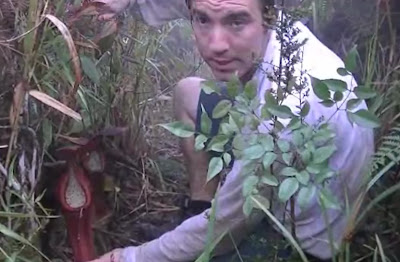
Discovering New Species of Pitcher Plant in the Philippines - Stewart McPherson

At the Carnivorous Plant Society AGM, held on 21 April 2012, members were treated to a 25 minute video of Stewart McPherson's latest documentary:

Discovering New Species of Pitcher Plant in the Philippines


Stewart takes you on a journey of discovery on a previously unexplored mountain, Mount Anipahan, and then on to Mount Kiamo on Mindanao.  Enduring energy sapping difficult terrain the expedition proved fruitful unearthing one new pitcher plant, Nepenthes. spec. "Anipahan". The documentation also contains exclusive video footage of N. ceciliae and N. pulchra, two new pitcher plants recently discovered on a previous expedition by another group of Nepenthes enthusiasts.

The initial discovery of N. ceciliae and N. pulchra was made by Fulgent Coritico, a student of Dr. Victor Amoroso, who was unsure about them and showed Thomas Gronemeyer, Marius Micheler and David Marwinski at the Central Mindanao University. Thomas, Marius and David realised from dried specimens that they were probably looking at some new species and organized an expedition to Mount Kiamo, together with Fulgent. On Mount Kiamo, they also saw N. pulchra and realized that they had found not one, but two new species

The expedition did not yield further discoveries of the giant Nepenthes species Stewart discovered on previous trips to the Philippines, N. attenboroughii and N. palawanensis, but with the new plant found proved a huge success and the documentary provides a fabulous insight into the world of discovery.

If you would like to see the documentary, and I strongly urge that you do, it can be viewed free at: Discovering New Species of Pitcher Plant in the Philippines

N. pulchra
N. ceciliae
On behalf of the CPS I would like to thank Stewart for supplying us with a copy of the documentary, and for his continued great support.

Friday, 13 April 2012

National Carnivorous Plant Day

At a Special General Meeting the Carnivorous Plant Society voted on the idea of having a National Carnivorous Plant Day (NCPD), which originally came from a band of bell-ringers.

We loved the idea and a vote was made to make 2nd April the NCPD, to commemorate the start of the new growing season and the life of Scottish-Irish, Governor of North Carolina and naturalist, Arthur Dobbs (1689-1765). It was Dobbs who first made the iconic Venus Flytrap known to botany, in a letter to English cloth merchant and naturalist-collector Peter Collinson, dated April 1759:

"We have a kind of Catch Fly sensitive which closes upon anything that touches it..."

Dobbs also happens to been born on 2nd April.

Arthur Dobbs (1689-1765)

Dobbs is recognised in several respects: playing a significant role in British politics, in particular improving the fortunes of Ireland's poor economic climate; his search to find the Northwest Passage into the South Sea (Pacific), albeit ending in failure; his scientific study "Concerning Bees and their Method of Gathering Wax and Honey" (represented at the distinguished Royal Society); astronomical observation (Royal Society); the colonisation and expansion of Northern America; contributing towards driving the French from North America; and of course the formal discovery of the VFT.

In recognition of the day bell-ringers Sue Tobell, Annemarie Adams, Ian Hamilton, William Pannell and Angie Pannell (left to right below) will mark the day each year, ringing one of the following methods: Triffid Surprise Minor, Sundew or Pitcher.


The Society are looking for other suggestions to mark the day and your comments would be very welcome.

Carnivorous Plants of the British Isles

Did you know that at least 13 carnivorous plant species, and 3 natural hybrids, are native to the British Isles. Yes 13! One less species than it used to be following the apparent extinction of Pinguicula alpina from 1919 (Druce, G. C. 1932), which used to grow in Scotland. And here they are:

Temperate Perennial Drosera

D. anglica - Great or English Sundew
D. intermedia - Oblong-leaved Sundew
D. rotundifolia - Round-leaved Sundew

D. intermedia
D. anglica
D. rotundifolia

Natural Hybrids Dosera

D x obovata (D. anglica x D. rotundifolia)
D x beleziana (D. intermedia x D. rotundifolia)

Temperate Perennial Pinguicula

P. vulgaris - Common Butterwort
P. lusitanica - Pale Butterwort
P. grandiflora - Great, or Large-flowerted Butterwort
P. alpina - Alpine Butterwort

P. lusitanica
P. vulgaris
P. grandiflora

Natural Hybrids Pinguicula

P. x scullyi (P. vulgaris x P. grandiflora)

Temperate Aquatic Perennial Utricularia

U. minor - Lesser Bladderwort
U. australis - Wavy Bladderwort
U. vulgaris - Greater Bladderwort
U. intermedia - Intermediate or Flat-leaf Bladderwort
U. ochroleuca - Pale or Yellowish-white Bladderwort
U. stygia - Nordic, or Artic Bladderwort
U. bremii - Bladderwort

U. vulgaris

There are also a few P. grandiflora forms described in Ireland, with white, pale-lilac or purplish-pink flowers.

What is perhaps the most surprising is the number of aquatic Utricularia. Aquatic Utricularia are thread-like and rootless plants that grow as a long network of thin stolons (specialised horizontal shoots or stems) blessed with fine branching photosynthetic leaves. Small bladder-like traps, which give rise to the plant's common name form on both the stolons and leaves in varying abundance. By-and-large the British Utricularia inhabit quiet, open, shallow nutrient-deficient pools, ponds and ditches.

Wednesday, 7 September 2011

Invite to Tepui Documentary Premier

As you may be aware, carnivorous plant expert and geographer/explorer Stewart McPherson has been assisting a non-profit conservation effort to help the protection of the Tepuis - the spectacular "lost worlds" of Venezuela that are home to Heliamphora, and other incredible wildlife, much of which is found no where else on Earth.

Part of the project was to produce a non-profit conservation documentary to raise awareness of the incredible diversity of life found atop of Mount Roraima, and to highlight the conservation concerns that afflict this spectacular lost worlds.

It is Stewart's pleasure to invite you to the world premier of the film in London at the Royal Geographical Society on September 13th, 2011.

The event will be hosted by Michael Palin (presenter for many travel documentaries and lead in Monty Python) who is the president of the Royal Geographical Society.

Sir David Attenborough has also agreed to attend, if his filming commitments allow. He will be joined by some well known television presenters and personalities who will be amongst the first to view some world exclusive footage of when Jimmy Angel discovered the legendary Angel Falls, amongst incredible material of rare carnivorous plants, spectacular animals and the strangest landscapes on the planet.

The project, and the premier are both non-profit making. However, the conservation group behind the project does have to hire the RGS venue, and to cover costs, it is asking just £15.00 per ticket per person – available at http://lostworld.eventbrite.com . V.I.P. tickets, which include a drinks and canapés reception and the opportunity to meet our specially invited guests are priced at £50.00 and can be ordered by calling 0207 609 6775 and quoting 'Lost World'.

Stew really hopes to see you at the premier. It will be a night to remember!

Posted on behalf of

Stewart McPherson